
The day the swastika disappeared. Fred Harvey Era, 1930s — Navajo Silver.

The day the swastika disappeared.
Fred Harvey Era, 1930s — Navajo Silver.
On February 28, 1940, in Tucson, Arizona, representatives from the Hopi, Navajo, Apache, and Tohono O'Dum tribes signed a single piece of paper. It was a pledge that they would never again use swastikas in their crafts.
Until a few years prior, swastikas were commonly engraved on Navajo silverwork. Symbolizing the four cardinal directions, a talisman for good fortune, and the myth of the swirling log, the swastika had been a symbol of good luck for them for thousands of years.
We express our deepest regret that the Nazis defiled our sacred symbols.
— From the 1940 Declaration of Representatives of Four Tribes in Tucson, Arizona (Summary)
The two items that arrived this time were made "before" the ban was imposed.
The 1920s and 1930s. A network of hotels, restaurants, and souvenir shops developed by businessman Fred Harvey along the Santa Fe Railroad served as the gateway to tourism in the American West. Travelers from the East would purchase Navajo silverwork as souvenirs on their way to the Grand Canyon. That was the Fred Harvey Era.

Swastikas, thunderbirds, arrows—these were recurring motifs in Navajo silverwork. From mass-produced items for tourists to unique pieces meticulously crafted by artisans, each design held significance for the Navajo people of the time, and they passed through the hands of travelers as amulets of good fortune.
However, the history of this symbol began to change fundamentally from the moment Hitler adopted the swastika as a Nazi symbol in 1933.
— I. Thunderbird and swastika appliqué

ANTIQUE NAVAJO SWASTIKA & THUNDER BIRD APPLIQUE SILVER CUFF BRACELET — 1920~1930s
A thunderbird sits in the center, flanked by swastikas on either side. These three motifs were created separately and then fused onto the band as appliqués. Furthermore, the entire band is covered in stamp work. This density is proof that the craftsmen of the time spent hours stamping each and every detail.
For the Navajo, the Thunderbird is a supernatural being that controls storms, lightning, and rain. The swastika is a mythical symbol of the four cardinal directions and a swirling log, and a symbol of good fortune. This bangle, which combines the two, is a piece that encapsulates the spiritual worldview of the Navajo at that time, worn on the wrist.
ARZACH KAMAKURA
ANTIQUE NAVAJO SWASTIKA & THUNDER BIRD
APPLIQUE SILVER CUFF BRACELET
- era
- Around the 1920s-1930s
- material
- Silver
- Place of origin
- Made in USA
- Inner circumference
- 12.9cm
- opening
- 2.2cm
- width
- 1.0cm
- price
- ¥77,000 (tax included)
- situation
- Used — Shows signs of age, including discoloration, minor scratches, stains, and warping.
— II. Stampwork of Conchos and Swastikas
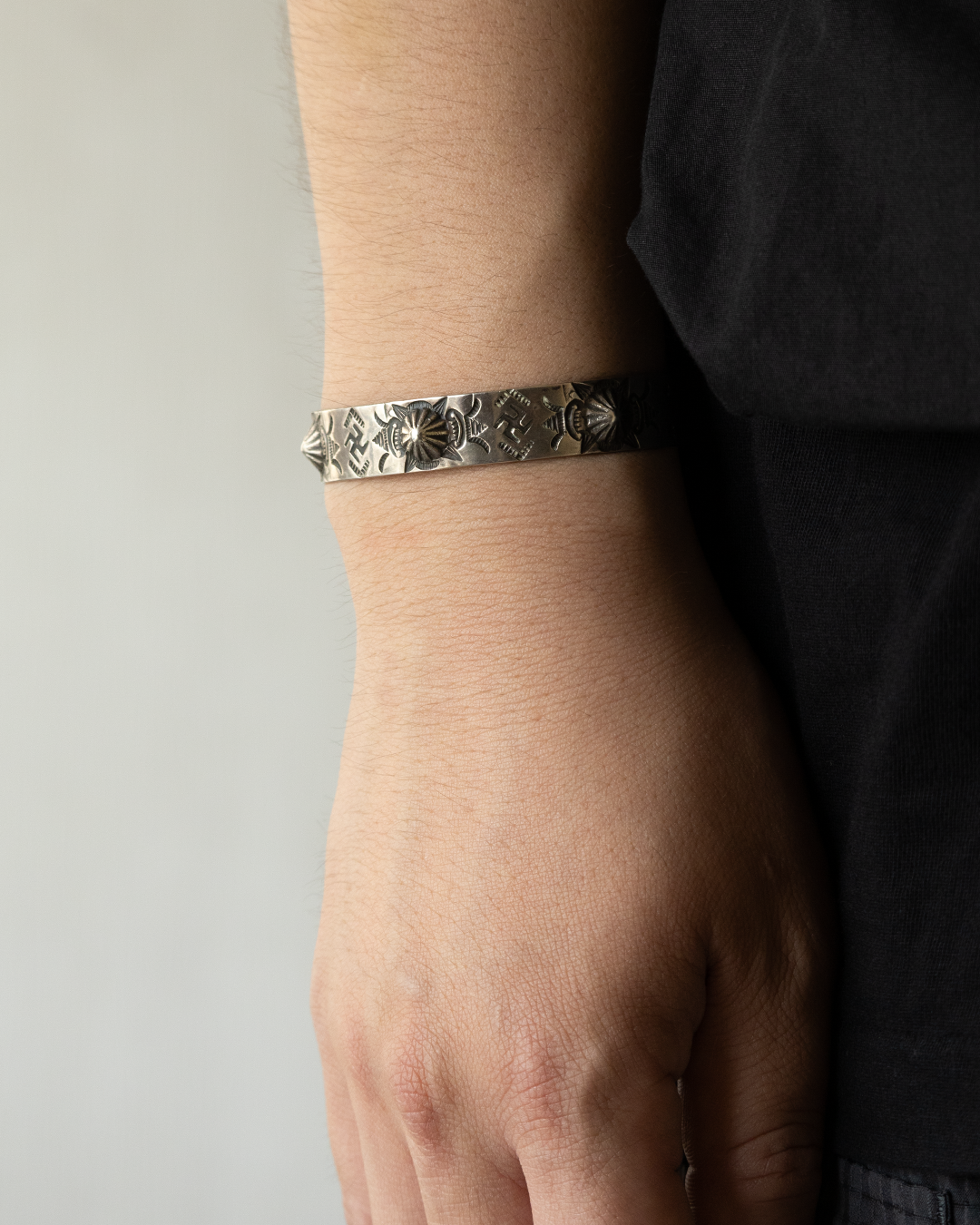
ANTIQUE NAVAJO SWASTIKA STAMPED & CONCHO REPOSED SILVER CUFF BRACELET — 1920~1930s
The conchos, spaced evenly apart, are formed using a repoussé technique, a reverse carving method where the silver is hammered from the back to create raised areas. The swastika and arrow stamps engraved between them are fine and precise, giving the entire bangle a sense of rhythm.
The inner circumference is slightly large. Suitable for both women with slender wrists and men. The wide opening allows for some adjustment. The volume of the concho makes a statement the moment you put it on your wrist, but surprisingly it doesn't feel heavy—the thinness of the silver and the hammered technique catch the eye before you even notice the weight.
ARZACH KAMAKURA
ANTIQUE NAVAJO SWASTIKA STAMPED & CONCHO
REPOSED SILVER CUFF BRACELET
- era
- Around the 1920s-1930s
- material
- Silver
- Place of origin
- Made in USA
- Inner circumference
- 14.0cm
- opening
- 3.2cm
- width
- 1.2cm
- price
- ¥88,000 (tax included)
- situation
- Used — Shows signs of age, including discoloration, minor scratches, stains, and slight warping.
— III. About the Fred Harvey Era
In 1887, the Santa Fe Railroad connected Chicago and Los Angeles. Fred Harvey established hotels, restaurants, and souvenir shops along the line. He offered tours called "Indian Detours," taking travelers to Navajo villages and the Grand Canyon, and selling them silver jewelry on the way back.
Navajo artisans met the demand. Swastika Thunderbird Arrow. They hammered silver symbols, considered "quintessentially Native American," into shapes that tourists would appreciate. There's no denying there was a commercial motive behind it. But at the same time, for Navajo artisans, the swastika was a genuine amulet of good fortune. They carved it with faith.
In 1938, the Fred Harvey Company requested that the swastika motif be discontinued. Its last appearance in the catalog was that same year. And then came the signature on February 28, 1940.
Since then, the swastika has disappeared from Navajo silver. Therefore, Navajo silver engraved with a swastika is proof that it was made before 1940.


When you pick it up, the density of the craftsmanship is immediately apparent before the weight of the silver. The fact that Navajo artisans in the 1930s meticulously crafted each and every strike to achieve this level of detail leaves a profound impression on your wrist, heavier than its actual weight.
These two pieces are witnesses to history precisely because they bear the swastika. They embody the handiwork of Navajo silversmiths in the American Southwest before 1940, and the eve of the moment when symbols were stripped of their meaning—all of which are present here today.
History is etched into the silver.
You can see it at our store in Yuigahama, Kamakura.
You can also purchase it from our online shop.
* As this is an antique item, there may be some discoloration, minor scratches, stains, and warping due to age. Please understand that this is characteristic of vintage items.
* The swastika has traditionally been used as a symbol of good fortune and harmony in many cultures, including the Navajo. This article aims to accurately convey its historical context.


